Best Massage for Headaches and Migraines: What Actually Helps

2026-08-22

Best Massage for Headaches and Migraines: What Actually Helps

Quick answer

For tension headaches, a Swedish massage with focused neck, shoulder, and scalp work is usually the best starting point, and deeper pressure helps when the same trigger points keep returning. For migraines, massage belongs between attacks and may reduce how often they arrive — it is not a way to stop an attack that has already started.

Tension headache or migraine? Start here

These are two different problems that happen to share a name in everyday speech. A tension headache usually feels like steady pressure or a tight band across the forehead, the temples, or the base of the skull, and it tends to follow a long day at a desk, a bad night of sleep, or a stressful week. A migraine is typically one-sided and throbbing, and comes with sensitivity to light or sound and sometimes nausea. Massage has a very different role in each case, which is why it is worth naming the difference honestly before you book.

Why massage helps tension headaches

Much of a tension headache is referred from muscles that never get a break: the upper trapezius across the top of the shoulders, the small suboccipital muscles where the skull meets the neck, and often the jaw. When those stay contracted for hours, the pain shows up in the head rather than where it actually starts. A session that gives real time to the neck, shoulders, upper back, and scalp works on the source instead of the sensation, which is why the relief usually outlasts the hour itself.

Migraines: what massage can and cannot do

Being clear about this matters more than selling a session. Massage is not a treatment that stops a migraine attack once it has begun — during an attack most people cannot tolerate touch, light, or movement, and the right response is a dark quiet room and whatever your doctor has advised. Where massage may earn its place is between attacks, by lowering the overall stress load and easing the neck tension that many people recognise as one of their own triggers. Think of it as a preventive habit, not a rescue.

Choosing the right pressure for your headaches

If your headaches track your stress and your sleep, a Swedish massage with extra time on the neck, shoulders, and scalp is the sensible default: calm, even pressure that lets the nervous system settle. If the same tight points come back week after week, deep tissue work on those specific spots tends to hold longer, provided the therapist builds pressure gradually rather than starting hard. And if your upper back and shoulders feel locked and the movement itself is limited, Thai massage adds assisted stretching that pressure work alone does not.

What to tell your therapist before starting

A few sentences change the whole session. Point to where the pain begins and where it travels, say whether it is a steady band or a one-sided throb, and mention what usually sets it off: screens, driving, short sleep, skipped meals, or stress. Make clear whether you are inside an episode right now or between them, and mention any medication you take for it. That lets the therapist decide how much of the hour the neck and scalp deserve and how firmly to work, instead of falling back on a standard full-body routine.

When to see a doctor instead of booking

Some headaches are not a massage question at all. Seek medical advice rather than a session if a headache arrives suddenly and severely, feels like the worst you have ever had, or follows a blow to the head. The same applies with fever and a stiff neck, with weakness, numbness, confusion, vision changes or difficulty speaking, with a first significant headache after the age of fifty, or when a familiar pattern clearly changes. A good therapist will decline the booking in those cases, and that is the correct answer.

Setting up a home session when your head hurts

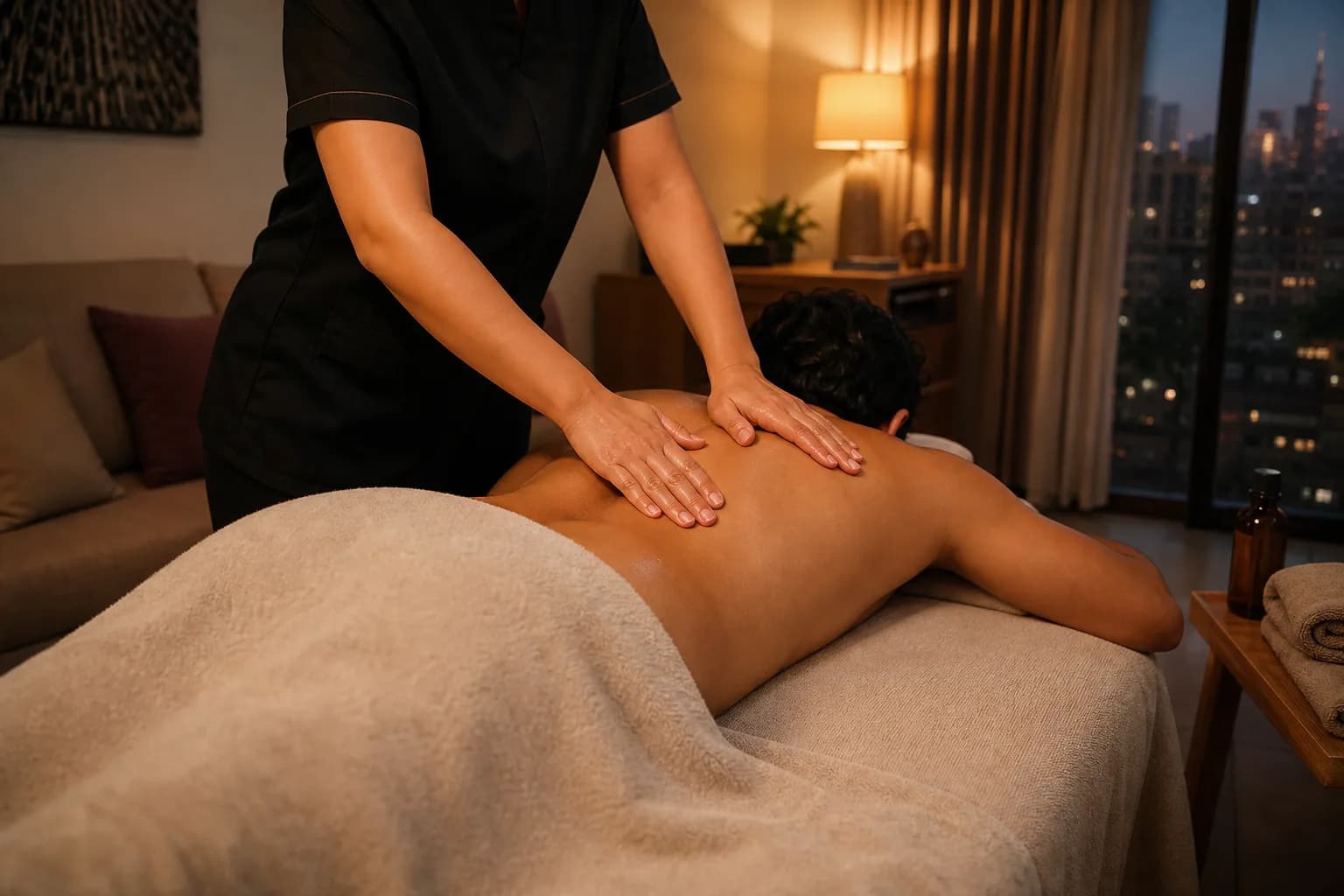
The environment does real work here. Dim the lights or draw the curtains instead of relying on overhead lighting, keep the room slightly cool, and silence your phone properly rather than leaving it face down. Eat something light beforehand if you have skipped a meal, and drink water afterwards. The genuine advantage of a session at home is what happens next: no glare, no traffic, and no drive back across Cairo undoing the calm — you can simply lie down and sleep.

What to change between sessions

Massage manages the tension; a few habits reduce how much of it accumulates in the first place. Raise your screen so your head is not tipped forward for hours, and stand up briefly every half hour instead of pushing through. Keep sleep and meals reasonably regular, since short nights and skipped meals are two of the triggers people report most often. Notice too whether you clench your jaw while concentrating or driving. None of this is dramatic, but together it usually does more than any single session.

Quick questions before booking

Can a massage stop a migraine once it has started?

Realistically, no. During an attack most people become sensitive to touch, light, and movement, and a session can make things worse rather than better. Massage belongs in the quieter stretches between attacks, where easing stress and neck tension may help reduce how often they arrive. If you are mid-attack, rest in a dark quiet room and follow whatever your doctor has advised.

Should I book while I have a headache or wait until it passes?

For an ordinary tension headache a session during it is usually fine and often helps, as long as you tell the therapist so the pressure stays moderate. For a migraine, wait. The rule of thumb is simple: if touch feels welcome, go ahead; if the thought of being touched makes you flinch, that is your answer, and moving the booking to a calmer day costs you nothing.

Is head and scalp work included, or only neck and shoulders?

Scalp and gentle head work can absolutely be part of the session — just ask for it when you book or at the start. For headaches it is usually most effective combined with neck, upper back, and shoulder work rather than on its own, since that is where most of the tension actually originates. If you would rather keep oil out of your hair, say so and the therapist will adjust.

How often should I book if I get headaches most weeks?

Many people with frequent tension headaches start with a session every one to two weeks for the first month, then space them out once the pattern eases. The aim is to book before the tension builds rather than only once the pain arrives. Keep a simple note of your headache days — if they are not becoming less frequent after several sessions, that is worth raising with a doctor.

Can strong pressure make a headache worse?

Yes, and it is one of the more common mistakes. Deep pressure on a neck that is already irritated, or firm work from the very first minute, can leave you with a heavier head than you arrived with. Pressure should build gradually and stay within what you can breathe through comfortably. If anything brings on dizziness, sharp pain, or a spreading numbness, say stop straight away.

Does massage help sinus or jaw-related headaches?

It can help with the jaw side of it. Clenching and grinding load the muscles around the temples and jaw, and careful work there along with the neck often eases that particular kind of headache. Sinus pain is a different matter: if it comes with congestion, facial pressure, or fever it needs a medical assessment first, and a massage while an infection is active is not advisable.

Helpful sources

Book a home massage in Cairo focused on the neck, shoulder, and scalp tension behind your headaches

Our services

Related articles